


Ochre pigment
The oldest surviving human artworks are vivid depictions of animals, humans, and spiritual motifs, created using ochres. Archaeological evidence suggests their use as far back as 250,000 years ago, making ochres the earliest known colourants employed by our species.
Ancient ochre artworks appear across the globe—from early sites in India and Australia to the renowned cave paintings of Lascaux, Altamira, and Chauvet in Europe—demonstrating the universality and enduring appeal of these natural pigments.
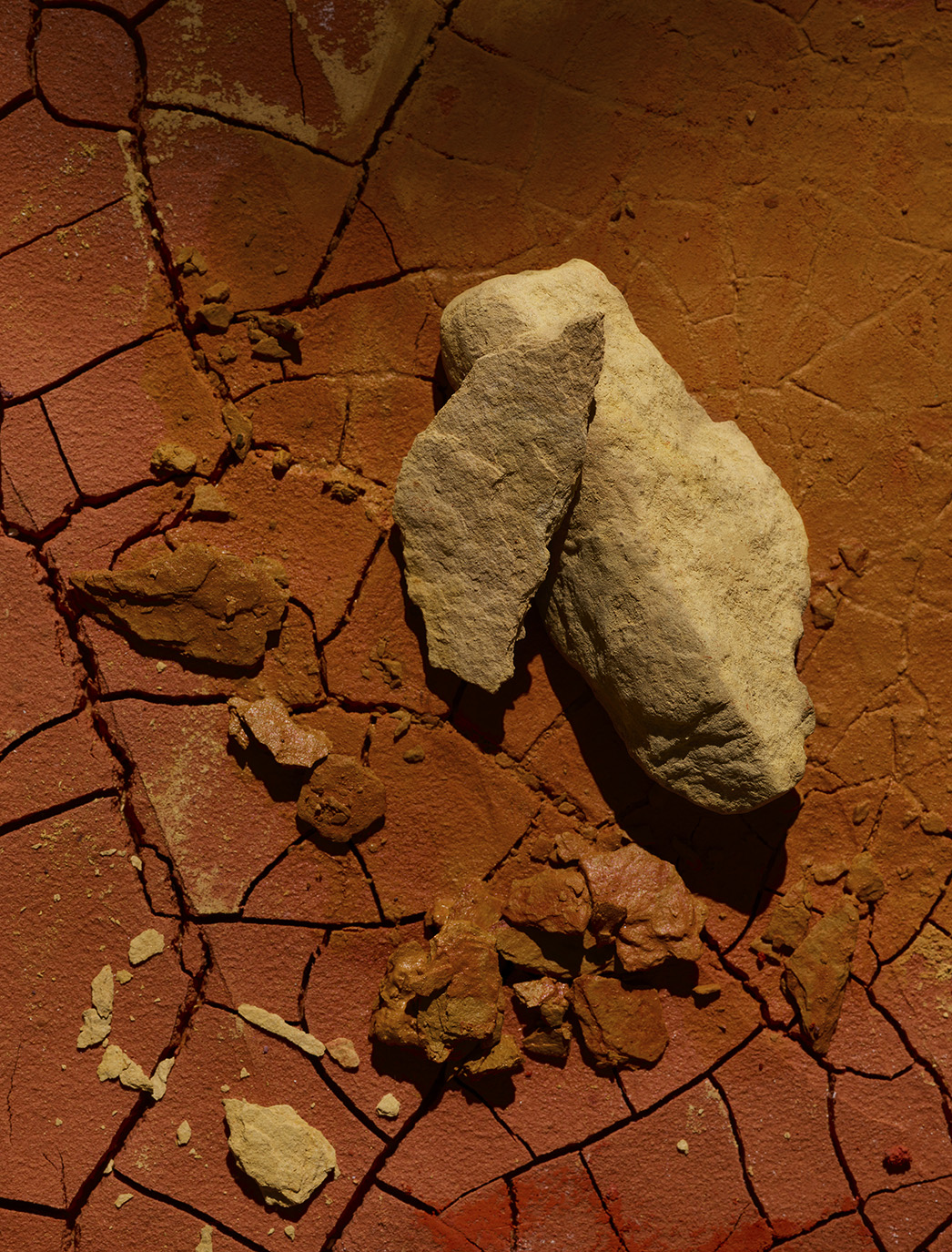
Ochres are naturally occurring iron-containing earths that provide a wide spectrum of yellows, reds, and browns. Their chemical composition is dominated by iron oxides and hydroxides—principally limonite (FeO(OH)·nH₂O) for yellow ochres and hematite (Fe₂O₃) for red ochres—though the exact hue varies according to the proportion of crystalline phases, particle size, and the presence of minor impurities such as silica, alumina, clay, or manganese.
Manganese-rich earths produce the characteristic dark browns of umber, while green earths such as terre-verte derive their hue from minerals like celadonite (K(Mg,Fe²⁺)(Fe³⁺,Al)Si₄O₁₀₂). Black earths are typically manganese oxides, and white earths (pipe-clay) consist primarily of kaolinite (Al₂Si₂O₅(OH)₄).
Technically, ochres are remarkably versatile. Early humans collected the naturally occurring mineral, then ground it against harder stone and mixed it with water to produce a fluid, workable paint. Later civilizations refined the process, washing the pigment to remove extraneous sand and impurities, drying it, and then grinding it to a fine powder suitable for binding in water, animal glue, egg, or oil.
Particle size and the degree of purification strongly influence opacity, brightness, and tinting strength. Coarse ochres produce earthy, translucent washes, while finely levigated ochres yield rich, opaque passages.
Thermal treatment expands the chromatic range of ochres. Yellow ochres, composed largely of hydrated iron oxide (limonite), can be roasted to remove water, producing deep orange or red hues. Moderate heat converts limonite to orange-brown tones, while stronger firing results in burnt reds known historically as ‘burnt sienna’ or ‘burnt yellow ochre’. Naturally occurring red ochres, by contrast, are rich in anhydrous hematite and require little or no heating. Particle morphology also affects appearance: smaller particles produce smoother, more opaque paint, while larger grains yield granular, textured surfaces.
Throughout history, ochres have been used in combination with other earth pigments to create complex palettes. Umber, containing iron plus manganese oxide, produces cooler brown-green tones; green earths like terre-verte provide muted, transparent greens useful in underpainting or flesh tones; black earths, from manganese, give deep shadows; and white earths offer tints and highlights. The interplay of these pigments—each chemically and physically distinct yet compatible in mixed media—has shaped artistic practice for tens of thousands of years.
Ochres remain technically significant due to their chemical stability, lightfastness, and inertness in most painting media. Unlike many modern organic pigments, ochres do not fade significantly with exposure to light, heat, or atmospheric pollutants.
Their ease of preparation, low toxicity, and wide range of warm, natural tones have ensured their persistence from prehistoric wall art to contemporary fine art. They are truly the foundation of the artist’s palette, providing both a historical link to early human creativity and a technically reliable material for modern practice.