

Phthalocyanine pigments

Phthalocyanine pigments are a class of modern synthetic organic pigments prized for their exceptional chroma, chemical stability, and versatility. Developed in the 20th century, they transformed artists’ palettes, providing vivid blues and greens with unparalleled lightfastness and consistency compared to historic inorganic and organic pigments.
Chemical Basis
Phthalocyanine pigments are macrocyclic, planar molecules incorporating a central metal atom, most commonly copper, within a highly conjugated nitrogen-containing ring system. Their intense colour derives from this extended π-electron system. By chemical modification (e.g., halogenation), the absorption spectrum shifts, producing blues or greens of high chromatic intensity. These pigments are insoluble in water and most organic solvents and exist as crystalline powders.
Commercial Variants
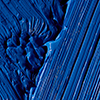
Phthalocyanine Blue
PB15 – Copper phthalocyanine, the standard blue pigment.
Colour: Deep, vivid blue, semi-transparent to opaque.
Technical Notes: Fine, crystalline powder; excellent lightfastness; chemically inert; mixes cleanly with yellows, reds, and whites.
Applications: Oil, acrylic, tempera, watercolour, inks, coatings.
PB15:3 – A “lakes” variant or modified crystal form of PB15 with slightly different particle morphology.
Colour: Rich, slightly greener blue than PB15; high chroma; slightly softer transparency.
Technical Notes: Often preferred in glazing techniques due to smoother, more uniform particle dispersion; retains the same high stability and lightfastness as PB15.
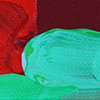
Phthalocyanine Green
PG7 – Monochlorinated copper phthalocyanine green.
Colour: Bright, vivid green with clean chroma.
Technical Notes: Semi-transparent to opaque; excellent lightfastness (ASTM I); chemically inert; compatible with all traditional and modern media.
Applications: Oil, acrylic, tempera, watercolour, inks, coatings.
PG36 – Dichlorinated or polyhalogenated variant of PG7, sometimes marketed as “green phthalocyanine” with slightly warmer, more opaque tone.
Colour: Strong, slightly bluish-green; excellent mass tone; less transparent than PG7.
Technical Notes: Used where more opacity or higher tinting strength is desired; retains full chemical stability; excellent mixing behaviour with yellows to create lime and leaf greens, or with blues to form deep teals.
Technical Characteristics
Transparency: Varies with particle size; smaller particles yield smoother glazes, coarser particles increase opacity.
Lightfastness: Exceptional (ASTM I); highly resistant to UV, acids, alkalis, and oxidation.
Mixing Properties:
Blues (PB15, PB15:3) mix cleanly with yellows for greens, reds for purples.
Greens (PG7, PG36) mix with yellows for lime greens or with blues for teals and complex shades.
Handling: Crystalline powders disperse evenly in water-based and oil-based media; particle morphology affects both opacity and glaze quality.
Historical Context
Phthalocyanine Blue (PB15): First commercialized in 1927–1935, initially for industrial inks and coatings. Artists adopted it for its vivid chroma, non-toxicity, and permanence.
Phthalocyanine Green (PG7, PG36): Introduced in the 1930s–1940s as chlorinated derivatives of PB15. Offered a modern alternative to chromium oxide and viridian greens, with superior brightness, tinting strength, and stability.
Impact: These pigments replaced many fugitive or toxic historical reds, blues, and greens, providing artists with reliable, high-performance materials for both fine art and industrial applications.
Phthalocyanine pigments exemplify the modern philosophy of pigment manufacture: engineered at the molecular level for maximum chroma, permanence, and versatility, offering artists precise control in colour mixing, glazing, and mass tone application, while maintaining exceptional chemical stability across all media.