

Verdigris pigment

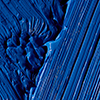
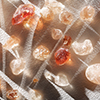
This blue-green pigment is formed by corrosion. Sheets of copper are suspended over a bath of vinegar, wine, or sour grape must, and the acetic acid vapours react with the metal to form a crust of copper acetates. These corrosion products are periodically scraped off, re-exposed to the vapours, and harvested again, producing the intensely coloured material known as verdigris.
Chemically, verdigris is not a single compound but a variable mixture of basic copper acetates, primarily Cu(CH₃COO)₂·H₂O together with related hydroxylated forms. Variations in humidity, acidity, temperature, and exposure time strongly influence the final colour, which can range from bright emerald green to blue-green.
Verdigris was the most vibrant and saturated green available to painters until the 19th century. Its exceptional chroma and transparency made it particularly attractive for foliage, draperies, and decorative passages. The English name derives from vert-de-Grèce (“Greek green”), while the Germans call it Grünspan (“green crust” or “Spanish green”). The Ancient Greeks described it poetically as “copper flowers”, and the Romans referred to it as aeruca, recognising it both as a pigment and as a useful corrosive substance.
Despite its beauty, verdigris is among the most chemically unstable of historical pigments. It reacts aggressively with sulphur-containing pigments such as ultramarine, vermilion, or orpiment, forming dark copper sulphides and causing rapid browning or blackening.
Even in isolation, sulphur compounds present in polluted air can corrupt the pigment, making verdigris extremely vulnerable in thin paint films. For this reason, historical treatises often advise that verdigris passages be completely sealed with varnish or isolated from adjacent colours.
In Persia and the wider Islamic world, manuscript painters attempted to mitigate this instability by modifying the pigment. Saffron was sometimes added, possibly acting as a weak antioxidant or complexing agent, to delay darkening and preserve the green hue. Other recipes combined verdigris with gum arabic, sugar, or honey to improve handling and short-term colour retention, though none provided a permanent solution.
During the 15th century, European painters and colourmen sought to stabilise verdigris by dissolving it in hot oleoresins or oil-resin mixtures to produce copper resinate. This translucent green initially appeared more durable and was widely adopted, particularly in oil painting. However, it soon became clear that copper resinate was highly light-sensitive and oxidised rapidly in the presence of air, turning from green to brown. As a result, many Renaissance and early Baroque paintings now display foliage and garments rendered in dull umber or olive tones where verdigris or copper resinate once provided vivid green highlights.
Verdigris is also highly reactive with binding media. In oil, it can catalyse oxidative reactions, embrittling the paint film and contributing to cracking and discoloration. In aqueous media, it is prone to migration and staining. From a conservation standpoint, verdigris is considered both chemically aggressive and inherently fugitive.
The introduction of chemically stable chromium-based greens in the 19th century—most notably viridian (hydrated chromium(III) oxide)—led to the immediate decline of verdigris in artists’ palettes. Because verdigris is toxic, corrosive, and environmentally hazardous, it is now rarely manufactured or sold, surviving primarily as a cautionary presence in historical painting rather than a viable pigment for contemporary use.