

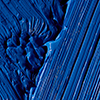
Azurite pigment

Purchasers of Azurite had to be extremely wary.
It is visually similar to lapis lazuli—an ore of vastly greater value—that buyers could easily be deceived. A conscientious apothecary or colourman would test a suspected sample by heating it until it was red-hot. Azurite decomposes on heating, losing carbon dioxide and water to form black copper(II) oxide (CuO) when cooled, whereas lapis lazuli, whose blue colour derives from the sulfur-containing aluminosilicate lazurite, remains structurally and chromatically unchanged under such treatment. This simple thermal test was one of the few reliable means of distinguishing the two minerals before chemical analysis.
Azurite is a basic copper carbonate with the chemical formula Cu₃(CO₃)₂(OH)₂. It forms naturally in the oxidised zones of copper deposits, often alongside malachite, and was mined throughout northern and western Europe, notably in Saxony, Hungary, France, and the British Isles. Its intense blue colour arises from d–d electronic transitions in the copper(II) ions, producing a vivid yet slightly green-biased blue distinct from the violet-rich hue of ultramarine.
The manufacture of azurite pigment is relatively straightforward but extremely labour-intensive. The mineral must be carefully crushed with a mortar and pestle, avoiding excessive grinding pressure that would reduce the particle size too far. The powdered stone is then washed repeatedly in water, sometimes with the addition of weak animal glue or fish glue, to separate pure pigment from lighter gangue minerals and copper salts. Levigation and decantation are repeated many times, with the finest particles carried off in suspension and the heavier grains retained. The dried pigment is then sieved or graded according to particle size.
Particle size has a decisive influence on both colour and working properties. Finely ground azurite produces a pale sky-blue tending toward turquoise or green, as smaller particles scatter light more strongly and expose more surface copper compounds. Coarser grades yield a deeper, more saturated blue but produce a gritty paint with low covering power.
Because of its relatively low refractive index compared to oil or egg binders, azurite is naturally translucent; achieving opacity requires the application of multiple layers, particularly when using coarse grades. Medieval painters often exploited this property, glazing azurite over lighter underlayers to build depth and luminosity.
Until the arrival in Europe of the violet-rich blue of lapis lazuli from Afghanistan, azurite was the pre-eminent blue of European painting. Even after ultramarine became known, its extraordinary cost meant that azurite remained the most commonly used blue in major works of the Middle Ages and Renaissance.
Contracts frequently specified where ultramarine was required and where azurite was acceptable, reflecting both aesthetic and economic considerations.
Azurite is moderately stable but chemically reactive. In humid or alkaline conditions it can slowly transform into malachite, turning green over time—a degradation visible in many historical paintings. It performs best in tempera and oil, but is unsuitable for fresco, where the alkaline lime environment accelerates its alteration. Conservation studies often reveal azurite passages that have shifted chromatically, altering the original balance of blues in historic works.
The words azurite and azure are both derived via Arabic from the Persian lazhward (لاژورد), meaning “blue”. In Europe, azurite was also known as lapis armenius or citramarino (“a blue from this side of the sea”), to distinguish it from oltramarino—a blue from beyond the seas—made from lapis lazuli and later known as ultramarine. This linguistic distinction reflects not only geography, but a hierarchy of cost, rarity, and prestige that shaped European painting for centuries.