



Kermes

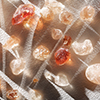
Kermes (Kermes vermilio), is a wingless scale insect that produces a deep red dye used extensively throughout Europe prior to the importation of cochineal from the Americas. The insect inhabits the branches of the kermes oak (Quercus coccifera) native to southern and eastern Europe.
The crimson pigment is derived exclusively from the resin-encrusted female insects, which are carefully harvested by scraping them from the oak branches during their reproductive season.
Once collected, the insects are dried and crushed, and the red dye is extracted by boiling the material in alkaline solutions, such as lye (potash or soda ash), or by steeping in water or mild acids. The colouring matter is principally carminic acid in trace amounts, combined with other chromophoric compounds bound in the insect’s body and excretions.
Historically, kermes was one of the most important crimson dyes in the ancient world. Archaeological evidence indicates its use as far back as Mesopotamia and Ancient Egypt, where it was highly prized for textile dyeing. Its trade routes spanned Europe, the Middle East, and Asia, making it a valuable commodity. Under Roman rule, Spanish kermes was so economically significant that it contributed substantially to the empire’s revenues, with some provinces paying half their taxes in the form of kermes.
The etymology of kermes reflects the historical confusion about its origins. The Sanskrit term krim-dja (meaning “worm”) directly references the insect, while Hebrew speakers called it tola’at shani (“worm scarlet”). In medieval Europe, it was often called baca (“berry”), illustrating the persistent misunderstanding that it was a botanical product. Other insect-derived reds, such as granum, were similarly misidentified as seeds or berries. Chaucer famously refers to cloth “dyed in grain,” meaning dyed crimson with kermes or granum. The durability and permanence of the colour gave rise to the metaphorical phrase “deeply dyed,” which survives in the modern English word ingrained.
Chemically, the colour of kermes is relatively stable for an organic dye of its era but is sensitive to light, alkalinity, and oxidation. When properly applied to textiles with mordants—particularly alum, tin, or iron salts—the resulting red exhibits remarkable fastness to washing and moderate lightfastness. The pigment tends to produce a warm, deep purplish-red, distinct from the brighter orange-red of later cochineal dyes. Its insoluble fraction, the dried insect body, can also be ground and used directly as a pigment in tempera or oil, yielding a warm, translucent red with moderate opacity and tinting strength.
With the 15th-century discovery of the New World, the introduction of cochineal (Dactylopius coccus)—containing a higher concentration of carminic acid—quickly displaced European kermes. Cochineal produced a stronger, more vivid red, required smaller quantities, and was easier to process. By the 1870s, the use of European kermes as a textile colourant had virtually disappeared. Nevertheless, kermes remains historically significant as the linguistic root of crimson and carmine, and as the precursor to modern cochineal-derived pigments, whose chemistry and application continue in artists’ colours today.
Technical Summary:
Chemical Basis: Carminic acid (C₂₂H₂₀O₁₃) with minor chromophores from insect resin.
Physical Form: Dried insect bodies; ground to powder for pigment use.
Processing: Crushing, boiling in alkali or aqueous extraction, optional mordanting.
Colour Characteristics: Warm, deep purplish-red; translucent; moderate opacity; stable in mordanted textiles.
Lightfastness: Moderate; more stable than many early plant-based reds.
Historical Use: Mesopotamia, Egypt, Greece, Rome, Medieval and Renaissance Europe; replaced by cochineal in the 16th century.