

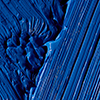



Smalt pigment

The name “smalt” derives from the Italian term smaltere, meaning “to melt,” reflecting the pigment’s origin as a ground cobalt-containing glass.
Like Egyptian blue, smalt is produced by heating a mixture of silica (SiO₂), lime (CaO), and an alkali flux—traditionally potash (K₂CO₃). Its vivid blue colour arises from the incorporation of cobalt oxide (CoO) into the glass matrix, replacing the copper responsible for the blue in Egyptian blue.
Chemical Composition and Manufacture:
The raw materials are melted together at high temperatures (typically 1100–1200°C) to form a cobalt-doped vitreous glass. Once molten, the liquid glass is poured into cold water, shattering it into fragments. These fragments are then sorted, washed, and ground to produce a pigment of controlled particle size.
Coarser fragments yield deeper, more stable blue tones but are gritty and difficult to apply, while overly fine grinding reduces colour intensity, as the cobalt ions are less able to absorb and transmit light in very fine particles. Optimal smalt balances particle size to retain chromatic depth while allowing workable application.
Technical Characteristics:
Smalt is a highly transparent pigment with moderate tinting strength. Its opacity is low, so multiple layers are necessary to achieve solid coverage. The pigment performs best in water-based media such as tempera or gouache; when used in oil, its colour is prone to fading over time. The oil binder gradually yellowed with age, diminishing the blue intensity and causing the paint to shift toward grey or dull blue. Smalt is chemically stable with most earth pigments, but its optical transparency and dependence on layer thickness make it technically challenging in fine detail work.
Historical Context:
Smalt was widely used in Europe from at least the 15th century as a cost-effective alternative to ultramarine and azurite. While long thought to be a European invention, recent research indicates that cobalt-doped glass and enamel had been used in Mesopotamia and Egypt several centuries earlier, particularly in jewellery, ceramics, and vitreous enamels, demonstrating that the optical and chemical properties of cobalt as a colouring agent were known in the ancient world.
In Europe, smalt was particularly valued for its affordability. It provided a vivid blue without the expense of lapis lazuli-derived ultramarine, though its technical limitations—transparency, coarseness, and colour fading in oil—restricted its use for fine, enduring painting. By the 19th century, smalt’s popularity declined with the introduction of more reliable cobalt blue (CoAl₂O₄) and synthetic ultramarine, which offered stronger chroma, ease of application, and superior permanence.
Technical Summary:
Chemical Type: Cobalt-doped potassium-lime-silica glass.
Physical Form: Fragmented, ground glass; particle size determines colour intensity and handling.
Colour: Deep blue; transparent; moderate tinting strength.
Stability: Chemically inert; transparent; prone to fading in yellowing oil binders.
Applications: Tempera, gouache, oil (historical); ceramics and enamels.
Historical Use: Europe from the 15th century; ancient Mesopotamia and Egypt; used as a cheaper substitute for ultramarine and azurite.
Smalt remains a pigment of historical significance, valued for its role in early European painting and as a precursor to modern cobalt-based blue pigments. Its combination of low cost, technical challenge, and subtle transparency continues to make it a point of interest for artists and conservators working with historic palettes.